Radar Ground-Target Recognition & Micro-Doppler Analysis
My earlier research developed automatic target recognition (ATR) for pulse-Doppler ground surveillance radar — deciding what kind of moving target a radar return came from. I designed a compact three-element feature vector built from the target’s radar cross-section and the short-time spectral variance of just 100 ms of radar audio, which kept classification fast enough for real-time use. A k-nearest-neighbour classifier trained on real radar data separated targets such as pedestrians and vehicles with over 80% accuracy across two datasets.
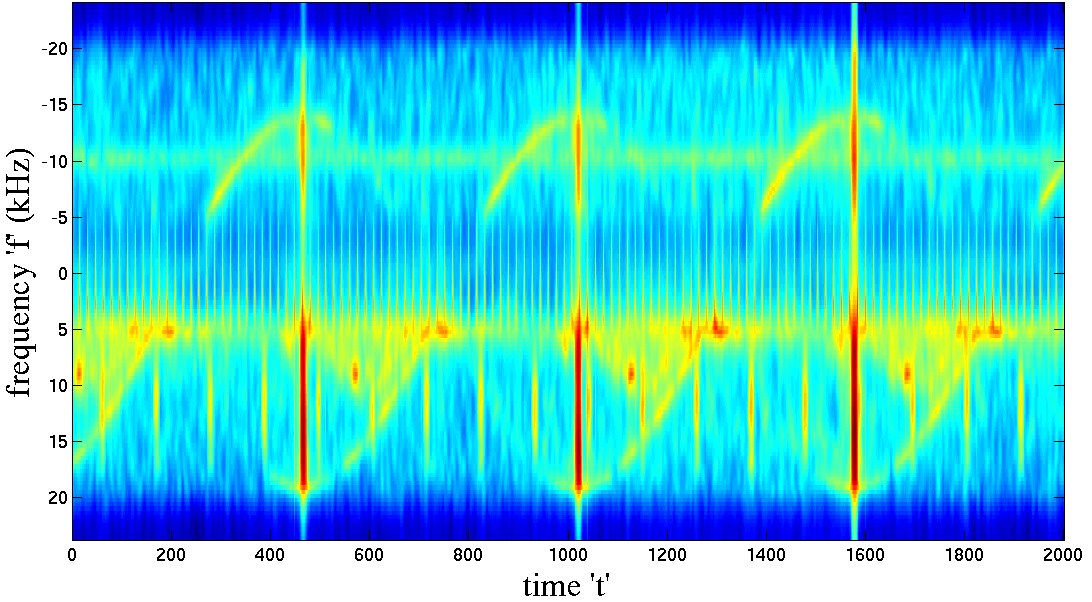
A complementary line of work improved the signal representation itself. I developed a high-resolution 2D time-frequency technique that resolves the micro-Doppler modulations of non-stationary targets far more clearly than a standard short-time Fourier transform spectrogram. The title image is the resulting time-frequency signature of a helicopter rotor — the periodic blade flashes and sinusoidal blade modulation are clearly visible. This work used the NUST NR-V2 ground surveillance radar.
Together, this signal-processing and pattern-recognition work laid the foundation for my later machine-learning research.
Time-Frequency paper (EuRAD 2013) →Target Recognition paper (INISTA 2011) →