Predicting Autism in Children from Eye-Gaze Patterns
This project predicts an autism (ASD) diagnosis from how children visually explore natural images. Using eye-tracking, we represented each child’s looking behavior two ways: as image-based gaze — fixation heat maps laid over the stimulus (the title image compares an ASD subject’s map with a typically developing subject’s) — and as scanpaths, the temporal sequence of fixations and saccades.
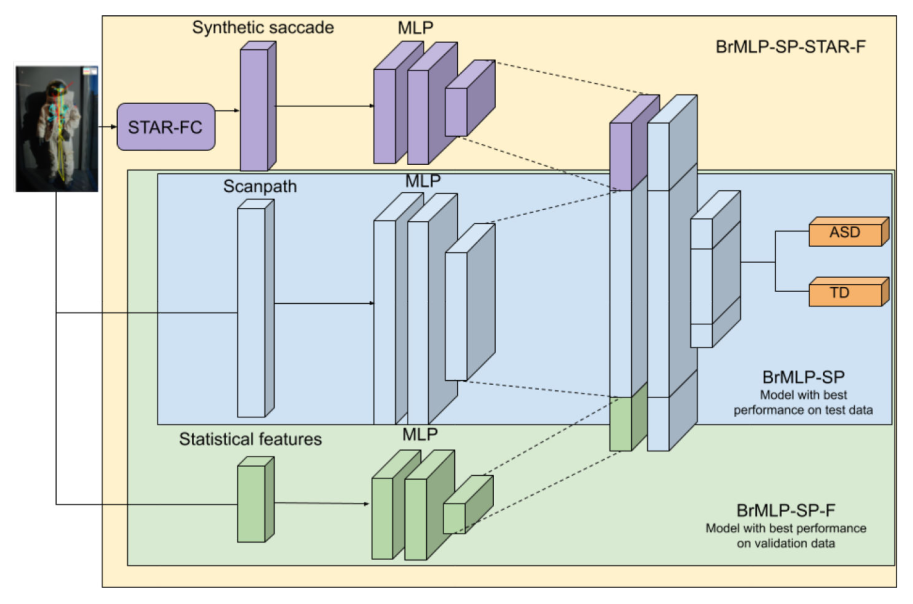
Clinical eye-gaze data is scarce, so a central contribution was generating synthetic saccades from a foveated saliency model (STAR-FC) to augment the real recordings. We trained CNN saliency classifiers together with siamese networks and scanpath-similarity measures (e.g. Fréchet distance) to distinguish children with ASD from typically developing children, and showed that synthetic gaze augmentation improves diagnostic accuracy when labeled data is limited. The work was published in Signal Processing: Image Communication (2021) and built on earlier results at the IEEE ICME Workshops (2019). Built in Python with PyTorch / TensorFlow.
Journal paper (Signal Processing: Image Communication, 2021) →Workshop paper (IEEE ICMEW, 2019) →